Panitia Peduli & Prihatin

Tentang Kami

Panitia Peduli dan Prihatin merupakan satu badan yang ditubuhkan bagi menyalurkan maklumat-maklumat tentang isu polemik dunia. Rasulullah Sallahu Alaihi Wa Sallam bersabda "Tidak sempurna iman jika kau tidur dalam kekenyangan, sedang jiran tetanggamu menderita kerana kelaparan". Mari ambil cakna isu dunia.

12 June 2012

Famous footballer continues Hunger Strike


Mahmoud Sarsak, 25, is a professional footballer from Rafah refugee camp. He was arrested about 3 years ago on 22nd July 2009 on his way to to join National Football team for a match in Balata refugee camp, West Bank. At Erez checkpoint he was arrested by Israeli Occupation and transferred to Ashkelon prison. 

Without any charge or trial, Israeli held him in prison under " Unlawful Combatans Law" which means the prison service has indefinite period for detention and this is truly unfair for him and his family which also banned to visit him in West Bank because all Gazans are not allowed to enter West Bank for a visit in prison. Until today, Mahmoud Sarsak has entered his 84th day on hunger strike and transferred to Ramleh Prison Hospital due to his critical health condition, he can die at any moment but he insists just to tell people the unjustice law against him. He didn't even know why he is being held in prison. 

Caring and curteous people are showing their solidarity in support of his hunger strike by organizing football friendly match to represent Mahmoud Sarsak position as a proud professional footballer. His family has not visited him since he was captured. 

a match being held in Gaza to show support

Reported by : Shahera Rahimi.

19 May 2012

SEMPADAN RAFAH DITUTUP SEMPENA PILIHANRAYA PRESIDEN MESIR


Pintu gerbang utama terminal sempadan Rafah Mesir

RAFAH - Pihak berkuasa Mesir telah memaklumkan kepada terminal Rafah Palestin berhubung niatnya menutup sempadan Rafah pada hari Rabu akan datang bagi meraikan pilihanraya Presiden Mesir yang bermula pada 23 Mei 2012.

Berhubung makluman, Pengarah Jabatan Pengurusan Sempadan di sebelah Rafah Palestin, Maher Abu Sabhah menyatakan dalam kenyataan khas kepada agensi berita SAFAbahawa Mesir telah memaklumkan secara rasmi mengenai penutupan sempadan Rafah pada hari Rabu berikutan berlangsungnya pilihanraya Presiden Mesir dan dibuka semula seperti biasa dari dua arah(Rafah Gaza-Rafah Mesir) pada hari Khamis.

Tambahan lagi, pilihanraya Presiden pusingan pertama berlangsung pada 23 dan 24 Mei 2012.

Demikian itu, Abu Sabhah berkata, penutupan sempadan tidak akan memberikan kesan sampingan kepada proses keluar masuk kerana tiada sebarang pendaftaran dilakukan untuk hari tersebut, demikian itu telah mengetahui lebih awal mengenai tarikh pilihanraya dan sesiapapun tidak dibenarkan mendaftar pada hari berkenaan bagi mengelakkan orang awam berpusu-pusu ke kaunter pertanyaan.

18 May 2012

Denmark moves against illegal settlement produce with new labelling scheme

COPENHAGEN, Denmark (Ma'an) -- Denmark is set to introduce a labeling system to denote products made in Israeli settlements, Danish media said Friday.

"This is a move that will clearly show consumers that this produce has been produced under conditions that not only the Danish government, but also the European governments have rejected," Danish Foreign Minister Villy Sovndal was quoted as saying by Danish online news-site Politken. 

"Then it is up to consumers whether they are prepared to buy the produce," he added.

The Danish FM said that stricter controls and labeling of settlement produce should be seen as part of the European Union's support for a two state solution.

Enforcing controls on settlement produce also shows the Palestinians that the world is against illegal settlement building.

The move targets illegal settlements and not Israel, the Danish FM added

adopted from : http://gazasolidarity.blogspot.com/2012/05/denmark-moves-against-illegal.html

15 May 2012


"7OREYA! WA TA7YA FALASTEEN!"
(Freedom! and Long Live PALESTINE!)

Ucapan Perdana Menteri Hal Ehwal Banduan Palestin dan sambutan rakyat Palestin berikutan kemenangan mengakhiri Mogok Lapar. 
-Dipetik dari Al-Jazeera TV.

14 May 2012

Allah Maha Mendengar, Maha Pengasih dan Maha Penyayang.


Kemenangan buatmu ,Palestin. Gambar rakyat Palestin keluar meraikan kejayaan mereka hari ini dalam menegakkan keadilan terhadap nilai-nilai kemanusiaan.

Desakan para tahanan akhirnya dipersetujui oleh pihak berkuasa Israel! Lebih kurang 1,200 tahanan politik di penjara Israel telah menghentikan mogok lapar mereka setelah beberapa tuntutan mereka berkenaan keadaan dan hak tahanan di penjara akhirnya diterima oleh Perkhidmatan Penjara Israel. Kemenangan perang tanpa senjata oleh para tahanan dengan berlapar, mengorbankan kesihatan mereka sehingga ke tahap kritikal dan tanggungjawab penduduk sedunia yang cintakan keadilan dan keamanan ini membuktikan kekuatan dan kemampuan media mendesak kekejaman untuk tunduk dan akur dengan keadilan.

Hasil kesepakatan aktivis Palestin dan penyokong keamanan dari seluruh dunia untuk mencetus sokongan langsung dengan menjadikan lukisan simbolik bagi tahanan Palestin sebagai gambar profil di Laman Facebook, telah memperoleh kemenangan bersejarah dalam diri setiap tahanan, keluarga dan penyokong-penyokong kerana seramai 2 juta orang telah menukar gambar profil tersebut dalam masa beberapa jam sahaja. Melihat desakan yang begitu padu dan kekebalan tahanan untuk tidak mengalah semasa mogok telah melemahkan kepimpinan Israel yang tidak adil dengan bersetuju untuk menandatangani perjanjian tentang beberapa tuntutan yang diperjuangkan tahanan Palestin keseluruhannya.

Perjanjian tersebut telah ditandatangani di antara wakil dari Mesir dan pihak berkuasa Israel yang bertempat di penjara Israel itu sendiri. Setelah termetrainya perjanjian ini, seluruh warga Palestin terutamanya keluarga tahanan meraikan hari bersejarah yang kedua bagi mereka setelah berhari-hari melihat ahli keluarga mereka yang ditahan terbaring kelemahan akhirnya menghentikan mogok lapar dan menerima rawatan lanjut di hospital Israel apabila Jawatankuasa Antarabangsa Bulan Sabit Merah dan Doktor bagi Hak Asasi Manusia - Israel telah menggesa Israel untuk memindahkan banduan ke hospital selepas memberi amaran akan keadaan kesihatan mereka yang kini kritikal. Bermula hari ini, tahanan Palestin di penjara Israel telah dibenarkan untuk menerima lawatan ahli keluarga dengan tempoh yang lebih lama, tiada lagi tahanan seorang diri yang mengasingkan tahanan tanpa seorang pun ahli tahanan sebilik dan yang paling penting ahli keluarga dari Gaza dibenarkan masuk ke Israel untuk melawat. Sejak tahun 2006, ahli keluarga dari Gaza tidak pernah diberikan kelonggaran melawat tetapi hari ini mereka sudah boleh melihat sendiri keadaan ahli keluarga yang ditahan dan meluangkan masa bersama sewaktu mengadakan lawatan.

Namun, pada saat ini majoriti rakyat Palestin dan penduduk sedunia meriah dan gembira meraikan kemenangan ini, masih terdapat orang lagi tahanan yang masih meneruskan perjuangan mereka untuk tidak makan. Dua diantara mereka, Bilal Diab dan Thaer Halahleh berkeras untuk tidak menerima sebarang bentuk makanan,minuman dan bantuan kesihatan selagi apa yang dituntut mereka tidak diterima Israel. Kedua-duanya berpegang teguh dengan prinsip perjuangan mereka iaitu " it's either freedom or martyrdom " yang bermaksud mereka tidak akan mengalah selagi kebebasan bukan menjadi milik mereka walaupun terpaksa syahid. Mereka memberitahu ahli keluarga bahawa mereka akan terus fokus dan tidak lemah dengan kemenangan yang awal ini sebaliknya meneruskan hari ke-78 menahan lapar dan sakit. Bukanlah nama yang diinginkan andai kemenangan menjadi milik mereka sebaliknya inilah satu-satunya cara mereka mendesak agar penahanan mereka dihentikan segera atas sebab tiada tuduhan yang jelas dan arahan rasmi bagi mereka menjalani hukuman lanjut di penjara tersebut. Jadi perjuangan mereka masih belum selesai kerana tuntutan utama yang benar-benar mereka perjuangkan adalah untuk menggesa Israel menghentikan kebolehan mereka untuk menangkap sesiapa sahaja yang dikira mengancam keselamatan mereka tanpa sebarang had tempoh penahan dan sebab yang munasabah. Israel hanya bersetuju dengan kelonggaran keadaan servis di penjara sahaja tetapi berkata bahawa mereka akan terus mengamalkan aktiviti penangkapan selagi perlu demi menjaga keamanan negara mereka.

Setelah merasakan keadaan diri semakin kritikal dan mungkin tiada harapan untuk tuntutannya didengar pihak Israel, Bilal Diab,27,pada hari ke-75 menahan lapar telah menulis wasiat kepada keluarganya. Wasiat tersebut merupakan hasrat beliau untuk ditanam di kedalaman tanah mengikut ajaran Islam, diedarkan gula-gula ataupun cenderahati pada majlis pengebumiannya sebagai satu perayaan berakhirnya perjuangan beliau, menyuruh abangnya Homam menjadi imam sewaktu sembahyang jenazah dan bekas tahanan mogok lapar, Khader Adnan yang meletakkan beliau di dalam kubur sebelum ditanam. Beliau menyampaikan ucapan terima kasihnya kepada seluruh warga Palestin, Arab dan orang Islam sedunia kerana telah menyokong perjuangan mereka yang bersih dari pertumpahan darah.

Poster gambar tahanan politik Palestin yang berada dalam tahap kesihatan kritikal yang dikeluarkan beberap hari lalu.Dari kiri, Thaer dan Bilal.

Oleh yang demikian sebagai seorang muslim sejati, tiada seorang dari kita yang patut menyerah dan berputus asa dari kekuasaan Allah S.W.T selagi kita yakin akan firman Allah dan hadis Rasulullah S.A.W. tentang hikmah disebalik mereka yang bersabar...


يا أيها الذين آمنوا استعينوا بالصبر والصلاة إن الله مع الصابرين
Wahai orang-orang yang beriman! Mintalah pertolongan dengan sabar dan solat, sesungguhnya Allah bersama-sama orang yang sabar.
 [Al-Baqarah: 153]


قال رسول الله صلى الله عليه و سلم للأشج أشج عبدالقيس إن فيك خصلتين يحبهما الله الحلم والأناة
Rasulullah Sallahu ‘Alaihi Wasallam berkata kepada al-A-syaj Abdul Qays; “Sesungguhnya pada dirimu terdapat dua perkara yang dicintai oleh Allah, iaitu kesabaran serta lemah lembut.”
 [Riwayat Muslim]


إن أشد الناس بلاء الانبياء ثم الذين يلونهم ثم الذين يلونهم ثم الذين يلونهم
“Sesungguhnya, manusia yang menerima ujian yang paling berat adalah para Nabi, kemudian orang yang mengikuti mereka, kemudian orang yang mengikuti mereka, dan kemudian orang yang mengikuti mereka.”
 [al-Silsilah al-Sahihah, al-Albani]


أم حسبتم أن تدخلوا الجنة ولما يأتكم مثل الذين خلوا من قبلكم مستهم البأساء والضراء وزلزلوا حتى يقول الرسول والذين آمنوا معه متى نصر الله ألا إن نصر الله قريب
Adakah patut kamu menyangka bahawa kamu akan masuk syurga, padahal belum sampai kepada kamu (ujian dan cubaan) seperti yang telah berlaku kepada orang-orang yang terdahulu sebelum kamu? mereka telah ditimpa kepapaan (kemusnahan harta benda) dan serangan penyakit, serta digoncangkan (dengan ancaman bahaya musuh), sehingga berkatalah Rasul dan orang-orang yang beriman yang ada bersamanya: “Bilakah (datangnya) pertolongan Allah?” Ketahuilah sesungguhnya pertolongan Allah itu dekat (asalkan kamu bersabar dan berpegang teguh kepada agama Allah). 
[Al-Baqarah: 214]


أحسب الناس أن يتركوا أن يقولوا آمنا وهم لا يفتنون. ولقد فتنا الذين من قبلهم فليعلمن الله الذين صدقوا وليعلمن الكاذبين
Patutkah manusia menyangka bahawa mereka akan dibiarkan dengan hanya berkata: “Kami beriman”, sedang mereka tidak diuji (dengan sesuatu dugaan)?Dan demi sesungguhnya! Kami telah menguji orang-orang yang terdahulu sebelum mereka, maka (dengan ujian yang demikian), nyata apa yang diketahui Allah tentang orang-orang yang benar-benarnya beriman, dan nyata pula apa yang diketahui-Nya akan orang-orang yang berdusta.
 [Al-Ankabut: 2-3]


لا يكلف الله نفسا إلا وسعها
Allah tidak memberi kesusahan seseorang hamba melainkan apa yang terdaya olehnya. 
[Al-Baqarah: 286]


ونبلوكم بالشر والخير فتنة وإلينا ترجعون
Dan Kami menguji kamu dengan kesusahan dan kesenangan sebagai dugaan; dan kepada Kami-lah kamu semua akan dikembalikan. 
[Al-Anbiyaa’: 35]

Editor: Shahera Rahimi, Unit Penerangan 3P (15/5/2012)


.HARI NAKBA.

RUMUSAN DI SEBALIK KESENGSARAAN RAKYAT PALESTIN SEJAK BERTAHUN LAMANYA...

Hari Nakba (Youm Al- Nakba) merujuk kepada " Hari Malapetaka " oleh seluruh rakyat Palestin pada tahun 1948.  Pada 15 Mei 1948, Israel telah mengisytiharkan kemenangan mereka menakluki tanah Palestin dan menganggap seolah-olah mereka telah berjaya menawan kembali tanah milik nenek moyang mereka dari tangan rakyat Palestin. Justeru tercetus satu bentuk pengusiran yang terbesar dalam sejarah hidup warga Palestin kerana seramai kira-kira 700 ribu rakyat mereka diusir ke negara-negara jiran seperti Jordan, Syria dan Lubnan. Dianggarkan sehingga ke hari ini, pelarian yang telah menetap di kem-kem tersebut adalah, Jordan (2 juta orang), Lubnan (427,057 orang) dan Syria  ( 477,700 orang ) termasuk beberapa keluasan tanah di Palestin yang telah dijadikan sempadan antara kerajaan haram Israel dengan Palestin seperti Tebing Barat (788,108 orang) dan Gaza (1.1 juta orang).

Walaubagaimanapun, istilah "Hari Nakba/ Hari Malapetaka" ini tidak dijadikan panggilan rasmi kerana ramai pelarian merujuk sejarah hitam yang berlaku sejak berpuluh tahun lalu sebagai " The Right of Return 1948 " yang mana mengingatkan mereka bahawa perjuangan mereka untuk kembali ke tanah air dan rumah milik mereka masih berterusan dan penaklukan Israel pasti jatuh suatu hari nanti. Replika kunci telah dijadikan simbol sebagai membuktikan bahawa keluarga yang telah diusir berpuluh tahun yang lalu masih menyimpan kunci rumah mereka dan segala jenis dokumen tanah hak milik mereka dengan harapan mereka akan pulang kembali ke rumah asal sebelum diusir keluar melalui Undang-undang Antarabangsa. Beberapa istilah lain yang turut digunakan adalah al-ightisab ("the rape"), al-ahdath ("the events"), al-hijra ("the exodus"), and lamma sharna wa tla'na ("when we blackened our faces and left"). 

Kunci menjadi simbol kepada tuntutan rakyat Palestin untuk pulang ke tanah asal mereka

Sejak tempoh pengusiran tersebut sehingga ke hari ini, tuntutan mereka menyeru persatuan-persatuan antarabangsa sedunia agar mengembalikan hak mereka untuk pulang masih gagal dan tidak kukuh oleh kerana terlalu banyak perkara berbangkit berlaku dalam kalangan Pertubuhan Bangsa-Bangsa Bersatu itu sendiri. Selain itu, faktor utama yang memberikan harapan yang tipis kepada rakyat Palestin adalah kerana Israel hanya akan bertolak ansur dengan rakyat Palestin sekiranya mereka bersetuju dengan cadangan kerajaan Israel iaitu "2 States Solution". Cadangan ini secara majoritinya tidak disokong oleh rakyat Palestin di seluruh dunia bukan hanya terhad kepada yang masih menetap di Palestin sahaja kerana Israel mendesak mereka untuk menerima sebilangan tanah yang telah dibahagikan itu untuk dijadikan Tanah Palestin yang merdeka untuk rakyat Palestin sahaja dan bersebalahan dengannya adalah Tanah Israel untuk rakyat Israel sahaja. Sudah tentu cadangan ini masih belum dibincangkan lebih lanjut kerana berdasarkan kaji selidik yang diadakn pada tahun 2007, seramai 1/3 (anggaran 26%) dari warga Palestin di Tebing Barat dan Gaza tidak bersetuju tetapi sebanyak 46% bersetuju dengan dwiwarganegara di dalam satu tanah yang sama. Sungguhpun kelihatan ramai yang menyokong tetapi kedua-dua pemerintah Palestin Hamas(di Gaza),Presiden Ismail Haneyeh dan Fatah, Presiden Mahmoud Abbas (di Tebing Barat) tidak pernah mengadakan pertemuan langsung dengan Presiden Israel, Benjamin Netanyahu bagi membincangkan perkara tersebut. Bangsa Arab yang menetap di Israel turut diberi peringatan agar tidak menyokong kemaraan rakyat Palestin di seluruh tempat berikutan dengan taraf hidup yang lebih tinggi dan terjamin yang mereka nikmati di dalam jajahan Israel berbanding mereka yang menetap di luar jajahan itu.

Ulang tahun Hari Nakba...

Sempena memperingati "Hari Nakba" pada 15 Mei 2012 ini, aktivis-aktivis Palestin sedunia yang menyokong perjuangan rakyat Palestin telah aktif menyebarkan mesej melalui internet dan media untuk memberitahu warga dunia akan kesengsaraan yang dialami rakyat Palestin dalam melalui detik hidup mereka bersama penjajah mereka yang terlalu kejam terutamanya tahanan-tahanan politik di penjara Israel yang telah mengadakan mogok lapar secara besar-besaran buat pertama kalinya. Tujuan mereka melancarkan mogok lapar adalah bagi menyampaikan mesej agar mereka tidak akan bersekongkol dengan kerajaan Israel yang telah menyeksa mereka sepanjang tempoh penahanan dan memberitahu bahawa mereka tidak sepatutnya menghabiskan riwayat hidup mereka di dalam penjara yang terlalu banyak peraturan yang telah memisahkan merekan dengan dunia luar terutama dengan keluarga sendiri. Kebanyakan tahanan ini telah ditangkap tanpa sebarang tuduhan jenayah dan bukti yang kukuh. Ada diantara mereka ditangkap kerana melancarkan tunjuk perasaan, melontar batu ke arah askar Israel, tidak menurut perintah askar atau pihak berkuasa Israel, menjadi aktivis yang berpengaruh di laman web dan banyak lagi tetapi mereka tidak diberikan hak bersuara untuk mempertahankan diri mereka di mahkamah bagi membuktikan mereka tidak bersalah sebaliknya hanya menunggu keputusan tempoh hukuman. Setelah ditangkap mereka dijatuhkan hukuman bertahun-tahun lamanya tanpa dibenarkan ahli keluarga melawat kecuali anak kecil di bawah 18 tahun sahaja. Tahanan-tahanan ini tergolong daripada pelbagai peringkat umur bermula dari pelajar sekolah rendah sehinggalah warga tua. Jadi aktivis-aktivis telah bersepakat pada tahun ini mereka beberapa lukisan rasmi bagi melambangkan tahanan-tahanan di penjara Israel yang sedang mogok lapar. Beberapa demonstrasi di seluruh dunia turut diadakan serentak dengan membawa slogan " In Solidarity with Nakba Day and Palestinian Prisoners on Hunger Strike ".

Beberapa rekaan lukisan yang menjadi lambang bantahan terhadap penahan rakyat Palestin dan mogok lapar. Warna coklat merupakan warna pakaian di penjara tahanan bagi membezakan antara tahanan politik dengan tahanan lain. Perkataan dalam bahasa Yahudi (Hebrew) pada pakaian mereka bermaksud " Shabas" merujuk kepada singkatan bagi Perkhidmatan Penjara Israel.

Pencetus mogok lapar yang pertama adalah Khader Adnan, yang telah ditangkap pada 17 Disember 2011 apabila beberapa orang askar bertopeng memecah masuk rumah mereka pada tengah malam di Arrabe, sebuah perkampungan Palestine berdekatan Jenin, Tebing Barat. Beliau dituduh atas sebab menjadi seorang aktivis yang boleh menggugat kemanan negara walaupun mahkamah Israel itu sendiri tidak menjatuhkan tuduhan tersebut secara rasmi tetapi beliau diarahkan untuk berada dalam tahana selama 4 bulan.Hampir setiap hari beliau disoal siasat secara kejam kerana diletakkan di atas kerusi yang bengkok dengan tangan diikat kebelakang sehingga menyebabkan beliau mengalami sakit belakang. Beliau turut memberitahu bahawa pihak berkuasa Israel mengugut untuk mencederakan keluarganya. Selama 66 hari menahan lapar beliau akhirnya dilepaskan pada 18 April 2012. 

Khader Adnan bersama dua orang anak perempuannya semasa hari beliau dibebaskan.


Kejayaan beliau telah mencetus semangat yang sama dalam jiwa tahanan-tahanan baru selepas pembebasan beliau.Turut menyambung mogok lapar tersebut ialah  Hana Shalabi,43 hari mogok lapar dan ramai lagi termasuklah yang sudah lama berada dalam penjara tersebut. Berikut adalah senarai yang telah dikeluarkan rakyat Palestin dari laporan setiap keluarga tahanan yang mengadakan mogok lapar :

Bilal Thiab, 76 Hari
Thaer Halahleh,76 Hari
Hassan Safadi ,70 Hari
Omar Abu Shallal, 68 Hari
Mohammedd Al-Taj ,60 Hari
Mahmoud Sarsak, 54 Hari
Faris Al-Natur ,47 Hari
Ja'far Ezz Al-Din ,53 Hari
Abdallah Al-Barghouthi ,32 Hari
lebih 2000 tahanan,27 Hari

Hana Shalabi di kem pelarian di Gaza.Pihak berkuasa Israel membebaskan beliau dengan syarat dihantar ke Gaza selama 3 tahun sebelum dibenarkan untuk pulang ke tempat asal, Jenin.

Disunting oleh : Wan Nur Syahirah Binti Wan Rahimi, Unit Penerangan 3P. (14/5/2012)

13 March 2012

No pretense of an excuse for continued Israeli attacks on Gaza


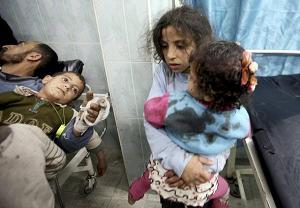
*Palestinians injured in Israel’s latest bombing campaign in Gaza (photo by Mohamed Majdalawi)
In August 2011, when the Israeli army bombed the Gaza Strip for nearly a week, killing 26 and injuring 89 more Palestinians, they at least had a pretext, no matter how transparently false — one which was immediately proven bogus by both their own Israeli Occupation Forces (IOF) spokeswoman and subsequent investigations.
Four days ago on March 9, 2012, when the Israeli army assassinated two Palestinians via a precision-fired “drone” (UAV, the technically accurate name) missile, they didn’t even have the pretense of a pretext to cling to. The missile, which hit a car in Gaza City’s Tel el Hawa district, killing two Palestinian resistance fighters, was the first of almost non-stop bombing that has continued throughout Monday. As of Monday evening, the death toll was 25 Palestinians, with another over 80 injured — many with critical, life-threatening injuries — and 3 Israelis injured from the crude, unguided rockets Palestinian resistance fire, with no signs that Israel would cease its murderous campaign. In the first attacks, the IOF assassinated Zuhair al-Qaisi, the secretary general of the Popular Resistance Committees (PRC), and PRC member Mahmoud Hanani.
Samer, a university student from Beit Hanoun, spoke Monday of the injured he saw at northern Gaza’s Kamal Adwan hospital: “The injured I saw there yesterday were all children and women.” Indeed, if the death toll is accurate, while a great many of the assassinated have been resistance fighters, the martyred — and nearly all of the injured — also include civilians, children, and elderly.
In Jabaliya refugee camp, one of the many Israeli bombings on Monday killed 65-year-old Mohammed Mustafa al-Hasumi and his 30-year-old daughter Faiza. Early Monday morning, IOF warplanes targeted the three-storey home of the Hammad family in Ezbet Abed Rabbo, injuring 33, including two critically so, and including nine below the age of 10 years old. Also on Monday, in the Strip’s northern Beit Lahiya, the IOF killed Nayif Qarmout, 14, and injured five other students wounded when the IOF-fired missile hit near them. On Sunday, Israeli bombing in a residential area killed Ayoub Assaliya, 13, and injured his seven-year-old cousin.
The Israeli attacks began Friday with the assassination of resistance fighters who were not participating in acts of resisting the occupation, but rather were travelling through a residential area of Gaza City. Enshrined in international law is the right to resist occupation. In contrast, the targeted assassination of people not engaged in combat is forbidden under international law. Specifically:
Extrajudicial executions are gross violations of universally agreed human rights that enshrine the right to life in accordance with Article 3 of the Universal Declaration of Human Rights and further cemented in Article 6 of the International Covenant of Civil and Political Rights. Extrajudicial executions are acts outside the realm of rule of law and hence deprive the targeted individual(s) of their right to life, as well as the right to defend themselves against charges against them.
According to provisions of IHL, people who live under foreign occupation enjoy special protection under Common Article 3 of the four Geneva Conventions. The Article stipulates that:
“[t]he passing of sentences and the carrying out of executions without previous judgment pronounced by a regularly constituted court, affording all the judicial guarantees which are recognized as indispensable by civilized peoples” are prohibited at all times and in all circumstances. Civilians are moreover protected against acts that constitute collective punishment. Collective punishment, intentional attacks against civilians and extrajudicial executions constitute war crimes in IHL.
Jenny Graham, an Irish citizen living in Gaza City, describes on her blog the pandemonium following the first Israeli attacks on March 9:
A day of bombardment from air, sea and land, The martyred and injured taken to Al Shifa. To the North, South, East and West and everywhere in between, no where escaped. Loud explosions constantly rattled the windows and shook the building.
… not only can Gazans not report their stories, share their fears or spread word of an attack, many can now no longer keep check on friends and family members [due to the 20 hour long power outages throughout the Strip].
… The father of one of the Martyrs sits on the ground outside, oblivious to the crowds surrounding him, his eyes vacant and empty, he will never see the world the same again.
Omar Ghraeib, a 25-year-old Palestinian who blogs when he has electricity, said:
I live in Tel el Hawa, Gaza City. The first bombings last Friday — which ignited the latest escalation — happened in Tel el Hawa. Since then, basically, from south till north Gaza, from east till west, nowhere is safe. They even bombed populated area and high-traffic areas. The bombing affects everyone, including myself and my family; it is not safe to go to work or school. But if I could leave, I wouldn’t! I want to stick with my people here, I am not better than them, and we are all in this together. Some might leave, but the majority won’t leave their lands, houses, and country.
An online letter from various Palestinian civil society groups, including the One Democratic State Group and different BDS groups, reads:
[Gaza has been] bombed by Apache helicopters and F-16 and V-58 fighter planes. Gaza has been enduring Israeli policies of extermination and vandalism since June, 2006. The Palestinian people have already been under siege for more than six years as collective punishment. Israel has turned the Gaza Strip into the largest concentration camp, reminiscent of Bergen Bilsen and Auschwits, with the largest population of prisoners in the world.
Mahfouz Kabariti, from Gaza City’s port area, says the bombing escapes no area: “The other day they bombed behind our house, maybe 500 metres away. Three were killed.” But like most Palestinians, he is accustomed to the tragedies of the occupation. “We are used to this life… but it is the kids dying, that’s the hardest thing.”
Saber al Zaneen, living in Beit Lahiya, said Monday evening: “The situation is extremely difficult in Gaza It’s very, very dangerous here. There are bombs every five to ten minutes, from warplanes, from zananas (UAVs). Today’s the fourth day we’ve been under Israel’s war … and no one is doing anything to stop it. It’s the beginning of a new war on Gaza, and it already feels as bad as the last war on Gaza in 2008-2009. The Israelis are bombing everywhere again: people’s homes, schools, cemeteries…No one is on the street, everyone is afraid.”
In his latest articleMax Blumenthal dissects the Israeli lies and motivations for their recent bombing of Gaza:
The Israeli army claimed that it initiated the assault on Gaza in order to kill two alleged militants who supposedly “masterminded” a brazen and deadly terror attack near the Israeli city of Eilat in August of last year. The army also claimed the two were planning a new operation.
As is so often the case, the Israeli army is lying. According to the army’s own investigation of the Eliat attack last year, the attackers were not from Gaza as Israeli government spokespeople initially claimed — they were Egyptian.
Finally, in November, Egyptian security forces arrested the suspected mastermind of the Eilat plot, shattering the Israeli army’s initial claims about Gazan culpability. By then, however, Israeli forces had already killed 30 Gazans in retaliation for an attack they had absolutely nothing to do with.
This weekend, the Israeli army reverted to falsely blaming Gazans for last August’s Eilat attacks, contradicting its own investigation and heaps of evidence proving the attacks were planned in Egypt and carried out by Egyptians. The army has no proof that the men it assassinated on Friday — Al-Qaissi and Al-Hannani — were involved in the Eilat attacks, or that they were planning any military operations. So in to manufacture a violent confrontation, the Israeli military simply concocted a lie that conceals what appears to be political considerations.
Blumenthal sees the recent Israeli attacks on Gaza as a means of garnering support for Netanyahu after a visit to the U.S., which did not result in the hoped for immediate go-ahead for an attack on Iran.
The renewed assault on Gaza coincided with Prime Minister Benjamin Netanyahu’s return to Israel after days of discussions in Washington with President Barack Obama about Iran’s nuclear program.
… Almost as soon as he limped back to Jerusalem in frustration, Netanyahu gathered with his generals to gin up a case for pounding Gaza. The Gaza Strip, with its warehoused population of stateless refugees, would serve as their punching bag and pressure release valve. They could not have their war on Iran — not yet, at least — but they could assault Palestinians in Gaza without fear of repercussions from Washington.
Likewise, Ali Abunimah’s recent in-depth analysis highlights a similar hypothesis — that Israel benefits from starting and continuing attacks on the 1.6 million people locked into the Gaza Strip:
So given all this, why has Israel decided to kill people in Gaza for no discernible reason? According to Bar’el inHaaretz it has everything to do with Israel’s effort to build support for an attack on Iran:
           Advocates of a strike on Iran couldn’t have hoped for a more convincing performance than the current exchange of fire between Israel and Gaza. “A million Israelis under fire” is only a taste of what is expected when Iran’s nuclear project is completed. When that happens, seven million Israelis will be under the threat of fire and nuclear fallout.
          …For Israelis, there is no better proof that no harm will come to them as a result of an attack on Iran than the performance of the Iron Dome anti-rocket system, which has demonstrated a 95% rate of effectiveness. The escalation in Gaza is good for Israel — that is, for that part of Israel that wants to strike Iran.
Further in his article, Abunimah elaborates on further reasons for the Israeli bombings throughout the Gaza Strip:
This weekend’s attacks have followed a typical pattern. Israel launches a lethal attack knowing full well that Palestinian resistance factions will respond. It then uses the response — dozens of rockets falling on Israel rarely causing injuries or damage — as the very pretext for continued bombing.
… Perhaps the most chilling explanation of why Israel was bombing Gaza came, again, from Yaakov Katz inThe Jerusalem Post:
             the IDF is using this as an opportunity to do some “maintenance work” in Gaza and to mow the lawn, so to speak, with regard to terrorism, with the main goal of boosting its deterrence and postponing the next round of violence for as long as possible.
So 12 year-old Ayoub Useila is not even an animal. He’s just part of a “lawn” of faceless nameless Palestinians, to be bombed into submission as routinely as an Israeli settler on stolen West Bank land maintains his suburban-style yard and swimming pool.
Finally, and critically, he cites statistics that are rarely cited, buried in the pages of Israeli propaganda:
… between September 2005 and May 2007 in which Palestinian armed groups fired 2,700 rockets toward Israel killing four people, Israel fired 14,617 heavy artillery shells into Gaza killing 59 people, including at least 17 children and 12 women. Hundreds more were injured and extensive damage caused.
In 2011, the projectiles fired by the Israeli military into Gaza have been responsible for the death of 108 Palestinians, of which 15 where women or children and the injury of 468 Palestinians of which 143 where women or children. The methods by which these causalities were inflicted by Israeli projectiles breaks down as follows: 57% or 310, were caused by Israeli Aircraft Missile fire, 28% or 150 were from Israeli live ammunition, 11% or 59 were from Israeli tank shells while another 3% or 18 were from Israeli mortar fire.
“To top things off,” Omar Ghareib writes, “Gaza’s Energy Authority announced that Gaza’s only power plant will be shutting down — completely — today, for the third time in a month, because of the lack of fuel. Gaza will sink under darkness again, but will be lit by the Israeli war machines.”
Dr. Hassan Khalaf, Deputy Health Minister in Gaza, said Monday that the combination of the latest Israeli attacks, the prolonged medicines shortage, and the continued lack of electricity meant for a critical health services situation in the Strip:
It is very critical, 180 of 450 of patients’ drug items are at zero stock; 200 of 900 of essential medical items are at zero stock. We lack many essential drugs, including those needed for anaesthesia, antibiotics, specialized milk for infants, treatments for neurological conditions like epilepsy, and cancer medications.
No electricity means no medical service. Electricity is the life of medical service, for all machines; the ICU is completely dependent on electricity, as is the operating theatre, kidney dialysis…
In his blog post, Abunimah links to a video interview with Shifa hospital’s Dr. Ayman Al Sahbani early on in the Israeli attacks, who says:
We don’t know what type of weapon was used. It led to severe burn from the upper torso; severe burn, black. We don ‘t know the type of chemical weapon used, because it is different from the other type of weapons. Used to kill, not to injure, to kill. The twelve martyrs, all of them severe shrapnel, severe injuries, and many of them without heads. In the past we saw burns, but last night, many of them direct trauma, many of them completely without their heads.
Some Palestinians in Gaza fear the worst for future days.
Saber Zaneen said Monday, “People hear rumours that Barack and Netenyahu want to send tanks in, for a big attack worse than 2008. We have no idea what’s going to happen.”
Posturing in the media, Netanyahu said on Sunday: “We extracted a high price from them and will continue to do so.” On Monday, he said that the Israeli army is “prepared to expand its activities [in the Gaza Strip] as much as is necessary.”
Asking, “is it enough yet?” Jenny Graham writes Monday night of the 25 martyrs and more than 85 wounded, including 27 children, 13 girls and five elderly since Friday evening.
Omar Ghraeib notes what many Gazan Palestinians have said: “The situation in Gaza is unbearable. No one would cope with it, but Gazans do, because they are used to darkness, lack of power, lack of fuel, lack of gas, lack of water, cold weather, and dire conditions. And in addition to all that, we remain under siege.”
by : Shahera, Information Unit (3P)

12 March 2012

Untukmu Palestine dan Syria

Assalamualaikum w.b.t

Bersempena dengan pelancaran Mini Pavilion (MAP),alhamdulillah Unit 3P telah bergabung tenaga dengan pihak penganjur MAP untuk menjayakan kempen kemanusiaan yang tertumpu pada isu semasa Timur Tengah dalam kalangan mahasiswa dan mahasiswi Mesir,khususnya Muhafazah Tanta. Mini Pavilion bakal berlangsung selama 7 hari bermula dari 15 Mac - 21 Mac 2012 inshallah. Pada mesyuarat yang telah diadakan hari ini, pihak MAP dan 3P sebulat suara untuk bersama-sama mengadakan pameran yang tertumpu pada isu Palestin dan Syria. 

Semua ahli PCT sangat dialu-alukan untuk menghadirkan diri sepanjang hari pameran bagi menunjukkan sokongan anda terhadap kepentingan dan perjuangan saudara Islam kita yang berada di kedua-dua negara bergolak ini. Sama-samalah kita ikhlaskan hati panjatkan doa buat mereka yang sedang dilanda musibah dan telah gugur sebagai syahid kerana kekuatan umat Islam itu adalah doa. Semoga syurga yang abadi menanti mereka sebagai balasan di akhirat kelak, ameen.


Maklumat lanjut tentang perjalanan program boleh dirujuk di :
 https://www.facebook.com/pages/Mini-Pavilion-From-Palestine-With-LoveMAP/203794872989424?sk=wall


"Ma tusbiqu min ummah ajalaha wa ma yasta'khiruun"
(tidak ada satu umat pun yang dapat menyegerakan ajalnya dan tidak pula menangguhkannya)

Laporan oleh : Shahera , Unit Penerangan 3P.


10 March 2012


NOTHING IMPOSSIBLE TO THESE OPTIMISTIC GAZANS TO TAKE PART IN OLYMPIC 2012, LONDON.

Bahaa Al Farra, above, will compete in the 400-metre Olympic race, trains at a gym in Gaza City, but next month he will go to Qatar to finish his preparations ahead of the Summer Games.
Bahaa Al Farra, above, will compete in the 400-metre Olympic race, trains at a gym in Gaza City, but next montBahaa Al Farra, above, will compete in the 400-metre Olympic race, trains at a gym in Gaza City, but next month he will go to Qatar to finish his preparations ahead of the Summer Games.


Darting down the bumpy streets of Gaza wearing a cheap pair of running shoes, Palestinian athlete Bahaa Al Farra dodges potholes and traffic as he trains to compete against the world's best athletes at the London Olympics.


Although an Olympic medal is highly unlikely, the 400-metre runner takes to the city streets for about three hours a day, speeding down crowded avenues in the morning before hitting the gym in the afternoon.


"It's not easy to be an athlete in Gaza," Al Farra said.


Al Farra is one of a handful of athletes who will compete under the Palestinian flag at the London Olympics. Although little has changed since Palestinians first participated in the Olympics at the 1996 Atlanta Games, they are now making the long-term investments they hope will bear results in a generation - building an Olympic-size swimming pool and asking for foreign aid for four large multipurpose gyms.


Four Palestinians will be headed to London for the 2012 Games, though none of them has reached Olympic qualifying standards, said Hani al-Halabi of the Palestinian Olympic Committee. Instead, they will be competing by invitation from the International Olympic Committee.


"I know that many people and experts say winning a medal is a fantasy, but I have a strong belief that nothing is impossible if you are determined," Al Farra said.


With medals unlikely, the athletes are mainly driven by the thrill of representing Palestine, even if they still live under full or partial Israeli control and their hopes of gaining independence remain unfulfilled after two decades of stop-and-go negotiations.


Al Farra's coach, Majed Abu Maraheel, recalled his excitement of waving the Palestinian flag at the 1996 Olympics, just two years after Palestinians won limited self-rule in parts of the West Bank and Gaza, the areas that are to make up Palestine, along with east Jerusalem.


"It sent a message to the world that the Palestinians also have the right to be in the games," said the 48-year-old Abu Maraheel, who competed in the 10,000 meters and finished 34th.


Al Farra's personal best of 49.04 seconds in the 400 is more than three seconds slower than the Olympic minimum, but he hopes to get faster by the time he walks into the Olympic Stadium.


Starting in April, Al Farra and female teammate Wuroud Maslaha, a 19-year-old 800m runner from the West Bank city of Nablus, will train for three months in a fully equipped athletic camp in Qatar. Once there, Al Farra will get to wear real running shoes, like the spikes he received as a gift from Qatar for competitions.


At about the same time, 20-year-old swimmer Ahmed Jibril will be heading to Spain to join 17-year-old Sabine Hazboun in training. Hazboun competes in the 50m freestyle and 50m butterfly, while Jibril swims the 400 freestyle, the Palestinian Olympic Committee said.


Al Farra, one of eight siblings, has a brother and a sister who also like to run. His sister had to stop when she became a teenager, in deference to conservative Gaza's strict social norms that frown on women running in public, but Al Farra's 11-year-old brother, not bound by such mores, now often runs alongside him.


Al Farra started training in a local sports club seven years ago. Al Farra prefers training in the streets because Gaza's outdoor track is often unavailable, since it serves many others, including school children and other athletes.


His mother has been supportive, he said, trying to serve healthy food despite the family's small income.


Framed pictures hanging on one of the walls of his family apartment show him at least year's world championships in Daegu, South Korea, where he finished last in his heat. This week, he is competing at the world indoor championships in Istanbul.


But medals will have to wait, according to al-Halabi, the Palestinian Olympic official.


The Olympic-size pool, being built in the West Bank town of Jericho, will be completed in four months, and the four gyms should be ready in two years, he said.


"To create an Olympic champion, you need at least 15 years," al-Halabi said. "We still don't have the required installations and proper budgets."


by : Shahera, Information Unit (3P)